Beyond Launch: Building the Infrastructure of the Orbital Economy
As launch costs fall, access to orbit is being unlocked. The next bottleneck — and opportunity — is building the infrastructure to operate there.
For most of the space age, launch was the bottleneck. That constraint is now dissolving. Over the past two decades, the cost of reaching orbit has fallen by an order of magnitude. SpaceX’s Falcon 9 reduced the cost of reaching orbit from roughly $55,000/kg on the Space Shuttle to below $2,000/kg today. Fully reusable launch systems like Starship aim to push this below $200/kg. What was once the exclusive domain of governments is becoming accessible to startups, corporates, universities, and even individuals. But cheaper launch does not create a space economy by itself. It simply removes the first barrier. The real bottleneck is shifting upward: from accessing orbit, to operating in orbit. Just as the internet required data centers, protocols, and server infrastructure before applications could flourish, space now requires its own infrastructure stack.
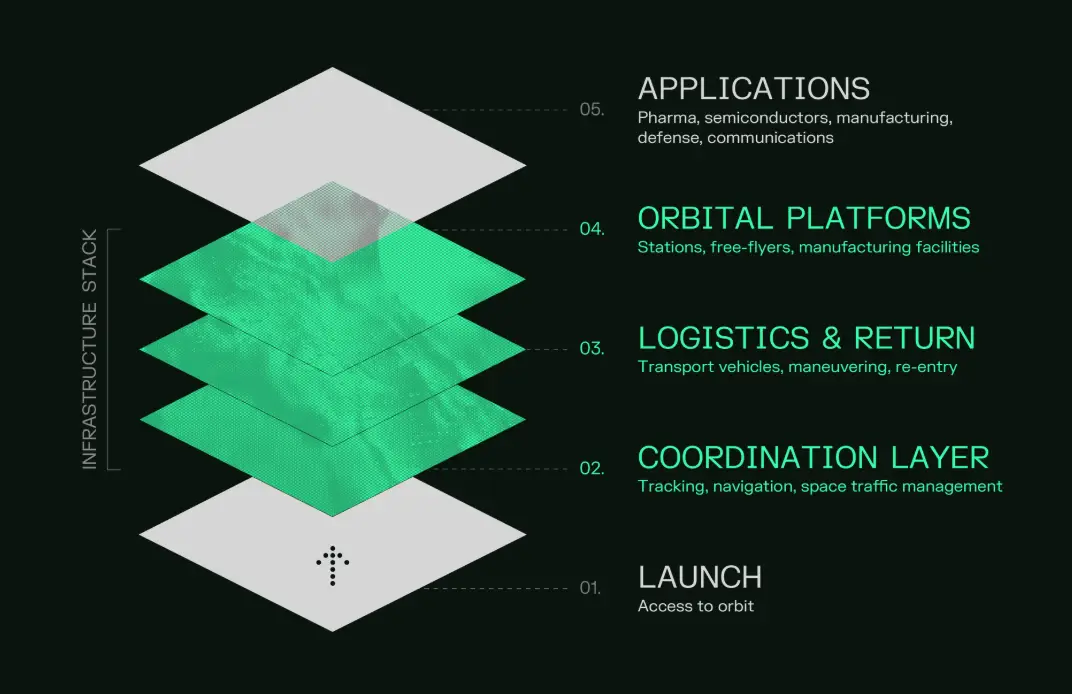
The emerging infrastructure layers required to operate, coordinate, and build industry in orbit.
SPACE REMOVES TERRESTRIAL CONSTRAINTS
As access to orbit becomes cheaper, the most important advantage of space may not be technical, but structural. Many critical infrastructure systems on Earth are constrained by regulation, permitting timelines, and physical limitations. Data centers, energy infrastructure, and industrial facilities face growing delays due to land use restrictions, environmental approvals, and grid access. Orbit operates under a fundamentally different set of conditions. Infrastructure deployed in space does not face many of the local land-use, environmental permitting, and grid constraints that shape terrestrial development. Instead, space operates under a different set of regulatory and technical boundaries related to launch, communications, and orbital safety. This does not eliminate economic or technical challenges, but it changes what is possible and how quickly it can be built. For example, space-based computing and industrial platforms are often framed as futuristic concepts. In reality, their near-term appeal may be more pragmatic: not because building in space is easier, but because it avoids the multi-year permitting, land-use, and grid connection processes that often delay comparable infrastructure on Earth.
ORBIT IS BECOMING AN INDUSTRIAL SYSTEM
Orbit has historically been treated as a deployment destination. Satellites were launched, operated independently, and eventually abandoned. That model is beginning to evolve. The first wave of space commercialization was largely about observing Earth from orbit. Space served as a vantage point, with value created on Earth from data collected in orbit. Today, a new phase is emerging in which orbit itself becomes a place of activity and value creation: manufacturing materials, processing data, assembling structures, and servicing spacecraft. More than ten thousand satellites now operate in low Earth orbit (LEO), supporting services such as communications, navigation, Earth observation, and defense. Tens of thousands more are planned. Orbit is becoming an operational environment where assets must coordinate, interact, and operate continuously. Operating in orbit requires entirely new infrastructure. Space needs its own equivalents of:
Traffic coordination: Tracking spacecraft and debris to prevent collisions.
Logistics and transport: Vehicles that move spacecraft between orbits or return materials to Earth.
Orbital industrial platforms: Stations or free-flying facilities that host research, manufacturing, and servicing activities in microgravity.
None of this exists at scale today. These missing layers define the next generation of space companies.
THE MISSING INFRASTRUCTURE
Three gaps are emerging as particularly critical. We believe these layers are also where many of the most compelling venture-scale opportunities will emerge, because they enable entire categories of downstream applications.
Space situational awareness: At orbital velocities, even small debris can destroy spacecraft. Continuous tracking, prediction, and autonomous coordination will become as essential as air traffic control is for aviation.
Orbital logistics and return capability: Industry requires movement and exchange. Spacecraft must be able to maneuver, interact, and return materials to Earth. This capability is particularly important for emerging use cases such as in-space manufacturing, where materials produced in orbit have to be delivered back to terrestrial markets.
Orbital industrial platforms: Orbit still lacks permanent industrial environments. Commercial stations and autonomous platforms are now emerging to provide controlled microgravity environments where research, testing, and manufacturing processes can operate continuously.
Until these infrastructure layers mature, many companies are forced to build far more capabilities in-house than they ultimately will.
VERTICAL INTEGRATION IS A SYMPTOM, NOT A STRATEGY
Industrial ecosystems do not emerge fully formed. In the early stages of an industry, companies often build far more in-house than they ultimately intend to. What is often described in venture circles as “vertical integration” is usually a symptom of a young supply chain. Critical components may not exist yet, suppliers can be slow, or reliability is uncertain. Companies bring these stages in-house because they remove bottlenecks on the critical path. As supply chains mature, these components often commoditize and margins compress, reinforcing the shift toward specialized suppliers. The automotive industry in the early 1900s looked similar. Early manufacturers produced engines, components, and tooling themselves before specialized suppliers emerged. As production scaled, supply chains deepened and companies focused on narrower parts of the stack. Space today is in a similar phase. Many of the make-or-buy decisions that look like permanent vertical integration are simply adaptations to a still-forming industrial ecosystem. But as the ecosystem matures, economic fundamentals will determine which parts of the stack ultimately prove viable.
NOT EVERY SPACE IDEA WORKS
Technical feasibility does not guarantee economic viability. Space only matters if it creates measurable value on Earth. For example, pharmaceutical companies may not care about space in and of itself. They would only invest if microgravity can enable commercially meaningful outcomes, such as stabilizing otherwise unstable crystal forms or enabling new drug formulations with real market impact. The same economic filter applies to infrastructure. In-orbit refueling and power transfer are technically achievable, but their economics depend heavily on the value of the underlying asset. For most commercial LEO constellation satellites, replacement is cheaper than servicing. As launch costs fall, deploying a new satellite often makes more financial sense than extending the life of an existing one. However, high-value geostationary orbit (GEO) satellites and certain defense systems can justify servicing economics. Space infrastructure will scale only where it creates a clear and defensible economic advantage. As this infrastructure begins to emerge, entirely new applications become possible. One early example is microgravity manufacturing.
ONE EARLY APPLICATION: MICROGRAVITY MANUFACTURING
Orbit offers a fundamentally different physical regime. Objects in orbit are in continuous free fall, creating microgravity: an environment where buoyancy and sedimentation disappear, and materials form differently than on Earth. This enables structures that cannot be produced terrestrially.
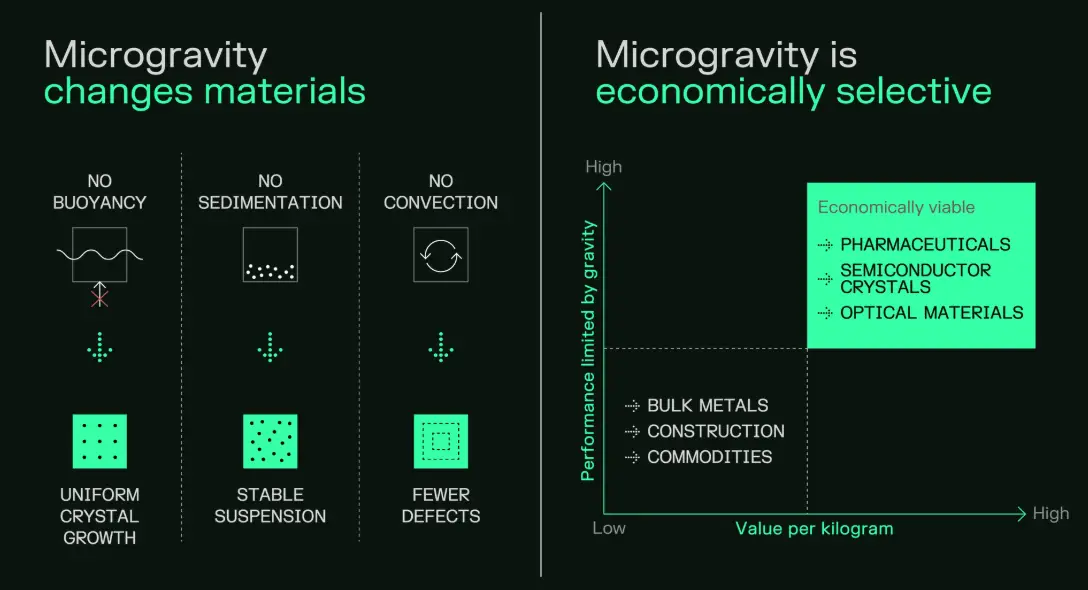
Microgravity changes how materials form, but only a narrow set of high-value products can justify manufacturing in orbit.
Microgravity manufacturing only makes economic sense where performance gains justify orbital costs. Three early markets stand out:
Pharmaceuticals and biologics: More uniform protein crystallization improves drug stability, formulation, and therapeutic performance.
Semiconductors and advanced materials: Higher-purity crystal growth improves performance in computing, photonics, and quantum systems.
Microfluidics and biological systems: Without gravity-driven convection, fluids behave predictably, enabling more precise biological assays, cell growth, and material synthesis.
Microgravity does not replace terrestrial manufacturing. It just enables what Earth cannot.
WHAT DEMOCRATIZED ACCESS TO SPACE REALLY MEANS
Democratization does not mean millions of people living in orbit. It means orbit becoming part of Earth’s industrial base. The most valuable space companies of the next decade may not only build rockets. They will build the infrastructure and applications that make orbit economically useful. If you are building infrastructure for the orbital economy, we would love to hear from you. Iris for the Visionaries Tomorrow team