Copper's Next Frontier: Smarter Chemistry, Not Deeper Mines
Copper demand doubles by 2035. The next wave comes from smarter chemistry, not deeper pits.
Copper is the lifeblood of electrification — running through every EV motor, wind turbine, and data center cable — and as a result, copper demand is set to double by 2035. Yet the way we produce it has barely changed in half a century. Smelting still supplies nearly 80% of global copper, refined through ever-hotter furnaces and marginal efficiency gains rather than true breakthroughs.
But the industry is shifting. After decades of mining, the richest near-surface copper deposits are largely exhausted, and average ore grades have fallen by about 25% over the past ten years. Miners are now turning to deeper, often lower-grade ores that cost more to process. New mines of that kind can cost upwards of $5B and more than a decade to permit, creating enormous tailwinds for technologies that can extract more from what’s already mined.
The next wave of supply must thus come not from deeper pits, but from smarter chemistry: processes that use less energy, unlock low-grade ores, and can operate closer to existing infrastructure. After a century of fire, hydrometallurgy is emerging as copper’s quiet revolution, using chemistry instead of heat to extract value from the low-grade ores that smelting leaves behind.
The chemistry is understood and the need is urgent. The real opportunity lies in what happens next. What works in the lab rarely scales cleanly to the field, where heat, airflow, and uneven rock layers dictate how the reaction unfolds. Innovators who solve those physical and economic constraints won’t just improve copper recovery; they’ll redefine what’s possible in industrial extraction.
TEACHING ROCKS NEW CHEMISTRY
In the chemical process called "leaching", copper is recovered from massive man-made heaps of crushed ore, where acid trickles through the rock to dissolve the metal over months or even years. However, most of the world’s remaining copper sits locked in chalcopyrite, a mineral that forms a thin, self-healing film when exposed to acidic solutions. Once that barrier forms, dissolution stalls, trapping copper in the ore and making large-scale recovery nearly impossible.
Unlocking this stubborn ore is key to closing the supply gap. A rare chance for a new generation of founders to redefine how the world extracts value from resources. An opportunity to reprogram the chemistry of extraction itself:
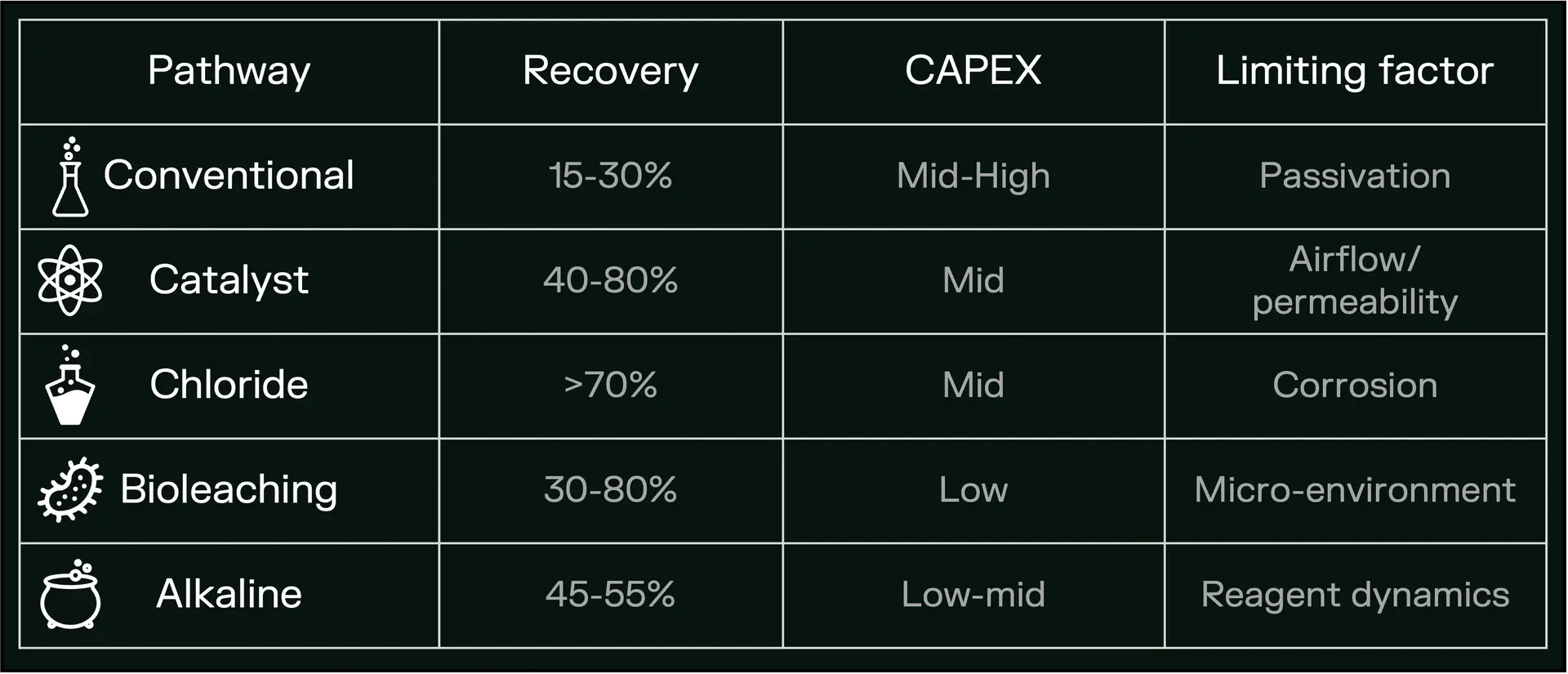
Catalyst-assisted leaching uses additives to strip away the self-healing passivation layer that chalcopyrite forms, boosting recovery from ~20% to 70–80% in pilots.
Chloride systems speed up copper dissolution but require corrosion-proof infrastructure.
Bio-leaching 2.0 builds on the fact that many heaps already host naturally occurring microbes that help convert minerals into soluble forms of copper. Instead of engineering new species, feeding and stimulating these native microbes could lift recovery toward 80%.
Alkaline lixiviants such as glycine are gentle, non-acidic solutions to dissolve copper. They’re promising for ore mixtures that contain both oxides (which dissolve easily) and sulfides (which resist acid).
Across the industry, every major miner is now testing hydrometallurgical routes – a quiet revolution turning copper extraction from fire to chemistry.
THE HIDDEN PHYSICS OF EXTRACTION
Behind every chemical pathway lie the same physical realities:
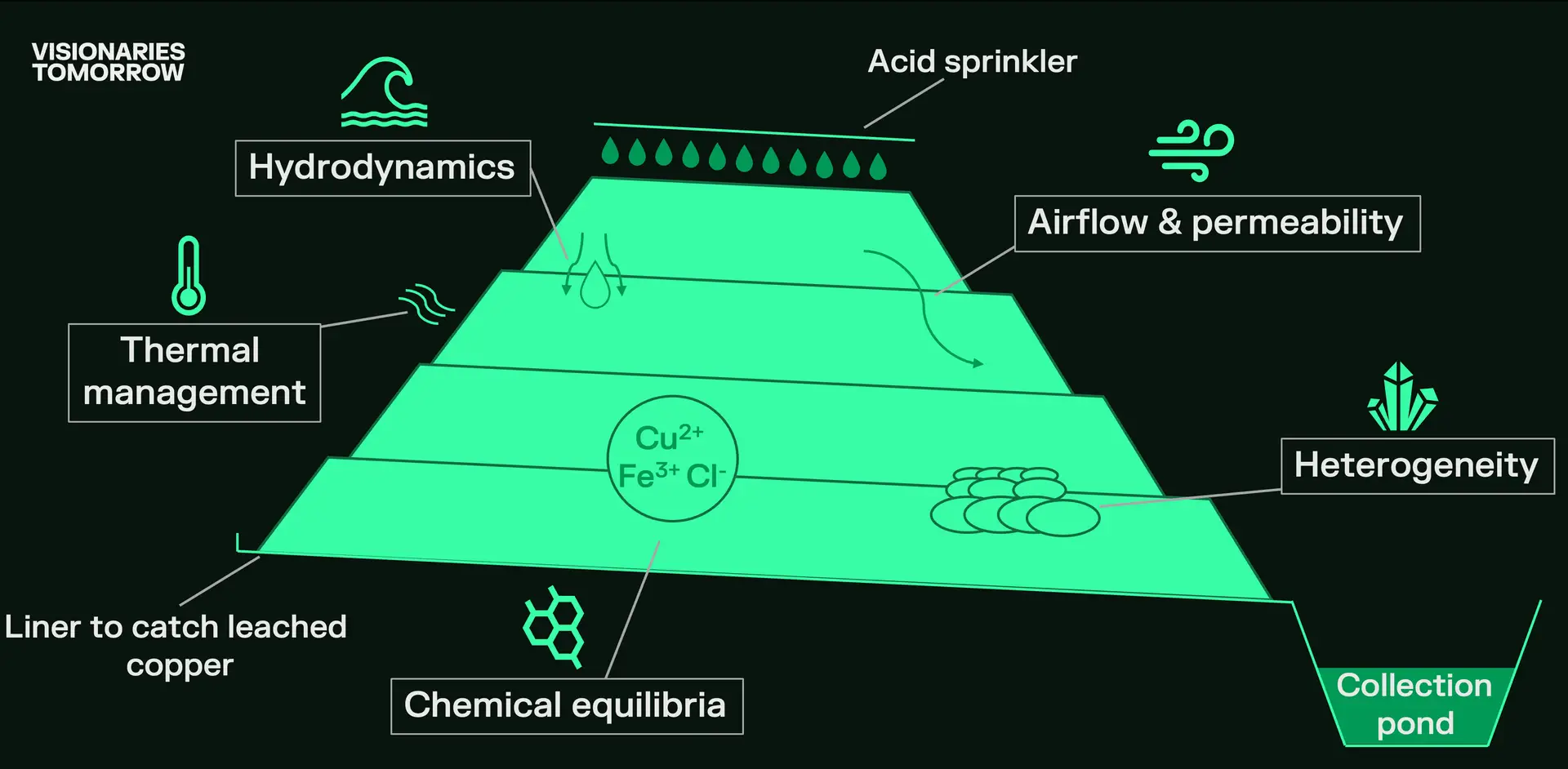
Airflow decides whether the heaps breathe or suffocate, as oxygen feeds the chemical and biological reactions that free the copper.
Hydrodynamics determine if leachate spreads evenly or shortcuts through cracks.
Temperature governs reaction speed and microbial survival.
Chemical balance of the solution — the mix of iron, copper, chloride, and acidity — determines how much copper actually dissolves.
Heterogeneity in grain size and mineralogy makes every heap a different experiment.
Even the best chemistry fails when the physics doesn’t cooperate, but those who design with physics, not against it, are rewriting what’s possible.
THE PHYSICS WORK BUT THE CFO SAYS NO
Even when lab and pilot data look perfect, most mining innovations die in the boardroom, not in the heap. But that's beginning to change as miners look for technologies that cut costs and extend mine life.
Miners don’t buy technology for novelty's sake. They buy risk reduction per tonne.
Procurement teams are trained to avoid surprises. CFOs prefer familiar reagents from established suppliers at fixed per-tonne prices over new performance-based models or revenue-sharing schemes that tie payments to results, like taking a share of the copper recovery uplift.
In heavy industry, a great innovation must survive not just heat, acid, and flow, but also budgeting cycles, internal politics, and safety committees. In the end, progress in mining isn’t limited by what we can invent, but by what the industry is willing to adopt.
LESSONS FOR DEEP TECH FOUNDERS
The challenges in mining tech mirror those across other deep tech domains. The science differs; adoption friction does not:
Engineer for physics at scale. Lab success means little if heat, airflow, and heterogeneity change how the system behaves.
Sell less risk per tonne, not a new paradigm. Reframe the pitch from disruption to de-risking, and from vision to value. Investors and customers care less about novelty than about lowering the cost, downtime, or operational risk per tonne of output.
Partner with incumbents early. Established equipment suppliers and other industrial majors lend credibility and distribution reach long before sales teams can.
Deep tech founders who understand both reaction kinetics and corporate kinetics will move faster than those who master only one.
In the end, copper’s bottleneck isn’t the ore or the chemistry. In fact, it’s the interface between innovation and inertia: that thin but stubborn passivation layer that forms between great science and real adoption. The founders who dissolve that layer won’t just unlock billions in stranded copper; they’ll show how to scale the next generation of industrial deep tech.
At Visionaries Tomorrow, we back the builders reprogramming the physics of industry. If you’re building at that frontier, we’d love to hear from you.
Sebastian, Thong, Iris, Oscar & Samy for the Visionaries Tomorrow team