Proxima Fusion Signs a Landmark Agreement to Build the World’s First Commercial Stellarator Fusion Power Plant - in Europe
Proxima Fusion signs a landmark agreement with RWE, the Free State of Bavaria and Max Planck Institute for Plasma Physics to build the world’s first commercial stellarator fusion power plant
Fusion is the holy grail of energy abundance. It is the most energy-dense way of generating power – the force that lights up the stars. By harnessing fusion on Earth, we can produce limitless clean energy and decouple economic growth from natural resource constraints. On February 26, 2026, our portfolio firm Proxima Fusion, Europe's fastest-growing fusion energy company, signed a landmark Memorandum of Understanding with Bavaria, RWE, and the Max Planck Institute for Plasma Physics (IPP) to develop the world's first commercial fusion power plant – in Europe. The program totals €2 billion, with 20% contributed by Proxima, and the remainder expected to be backed through non-dilutive government funding.
In parallel, Proxima has launched the Alpha Alliance, an industrial consortium of over 30 European companies – including Siemens Energy, TRUMPF, Thales, and Air Liquide – to industrialize the path to commercial fusion. We invested in Proxima in its Pre-Seed round shortly after its founding in 2023. To mark this moment, we sat down with co-founder and CEO Francesco Sciortino to ask him what it means – for fusion, for Europe, and for what comes next.
A CONVERSATION WITH FRANCESCO

Francesco, can you explain the significance of this agreement? Fusion has just crossed from research into execution, and Proxima is leading that transition. This agreement – a €2B program uniting a major utility, government, and one of the world's leading plasma physics institutes – sets the political and financial framework. And with the Alpha Alliance, we have assembled over 30 European industrial companies to build the supply chain that delivers it. Since founding Proxima in early 2023, we've developed and published a full-system stellarator power plant design: Stellaris. We built a team of over 130 physicists, engineers, and operators to not only advance the stellarator design but also produce actual fusion hardware. We now have everything to turn our designs and prototypes into reality – starting first with Alpha, a net-energy-gain demonstrator, and leading to Stellaris, the world’s first commercial fusion power plant – built here in Europe. There is still significant work ahead, but the pace of progress has been extraordinary. What is the biggest misconception about fusion today? That it's always decades away. Fusion, and specifically stellarators, have reached an inflection point. Three breakthroughs converged: i) Research in 2022 showed that optimized stellarators can confine high-energy alpha particles at power-plant-relevant levels. ii) Wendelstein 7-X, the world's most advanced stellarator, reached full operation and validated performance at reactor-relevant scale. iii) Breakthroughs in high-temperature superconductors now enable higher magnetic fields and more compact, economically viable devices. Combined with modern compute, this shifts fusion from a research ambition to an execution-driven engineering challenge. That's the kind of transition that creates generational companies. What's one thing you believed about fusion three years ago that turned out to be wrong? Three years ago, we had an unconventionally ambitious yet very clear mission and the right people to start it, but no detailed plan for how to get there. What I didn't expect was how nonlinear the progress would be. Every exceptional person who joined raised the bar for everyone else. It’s incredible to see how this compounds in accelerating progress and expands what we think is possible. Europe hasn't yet produced a deep tech success story at the scale we're aiming for. But the support we're receiving – from government, from industry, from the scientific community – shows real conviction that this time is different. Honestly, we have no other option but to get it right. What keeps you up at night? Execution speed. We're confident that quasi-isodynamic stellarators – the specific type Proxima is pioneering, optimized for plasma stability and energy confinement – can be built. We already know the specialized superconducting magnets we need for that are feasible. What we’re solving for now is navigating the unknown unknowns at this scale. We constantly have to find ways to radically compress timelines, deepen vertical integration, and strengthen our ecosystem – all in lockstep with each other. This is a foundational transition. Our team is not driven by instant gratification. We are here because we are obsessed with the civilization-scale opportunity behind fusion. Every week, every month matters. One day, we’ll tell our children how we made fusion work to power the world. Thank you, Francesco. Let's build it!
THE JOURNEY CONTINUES
Fusion has long been dismissed as permanently out of reach. With this agreement, it is stepping into industry – with a concrete program, committed partners, and a team executing at an extraordinary pace.
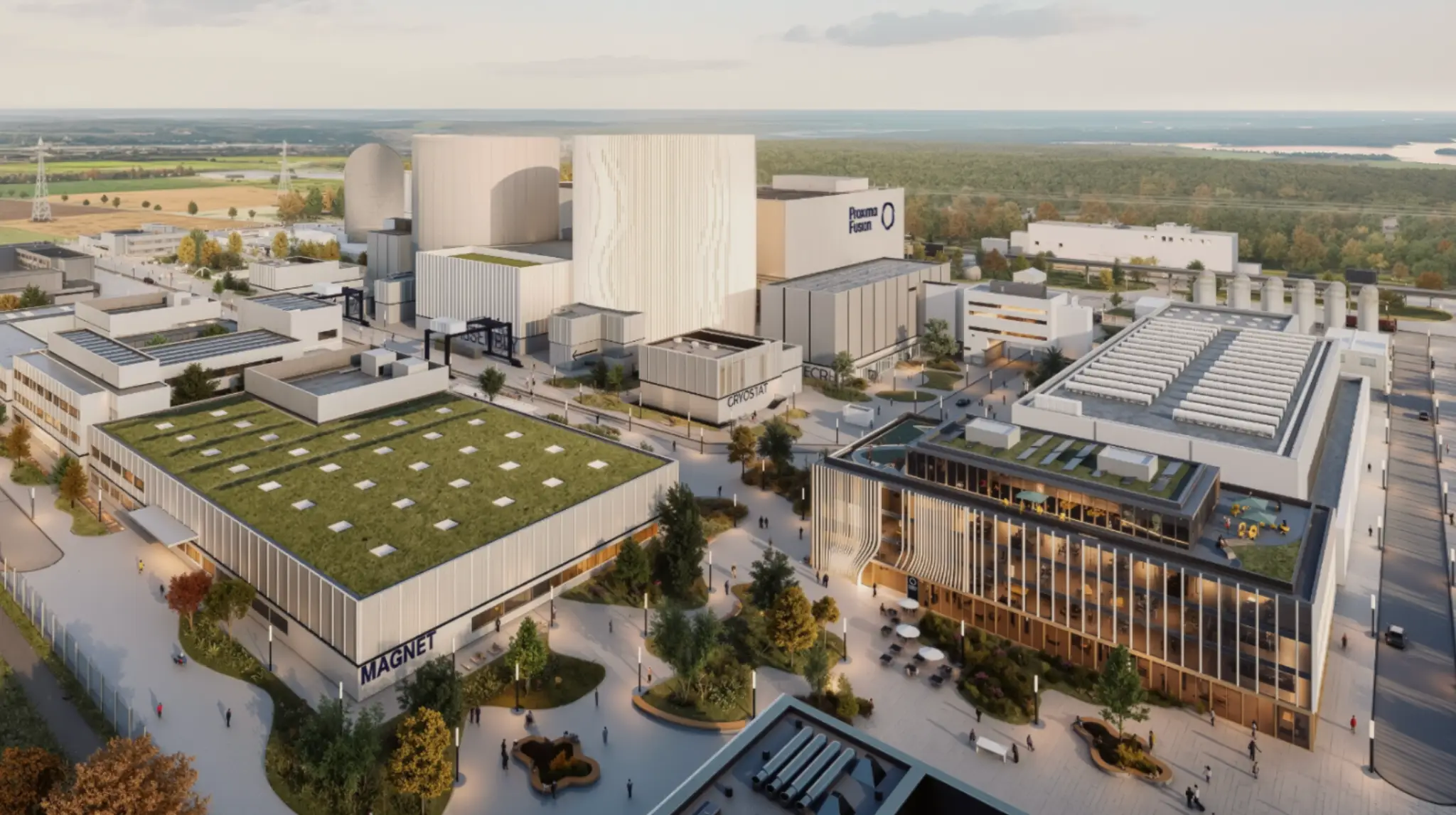
Illustration of the future site of Proxima Fusion’s Stellaris, the first stellarator-based commercial fusion power plant, in Gundremmingen, Germany
We are proud to have backed Proxima Fusion from its earliest days. We continue to be inspired by the team’s ambition, velocity, and humility – the driving forces behind building a brighter, more prosperous future. Read more here:
If you’d like to learn more or become part of the mission, don’t hesitate to reach out. The future of energy takes bold conviction and collective effort – but the upside is generational. Sebastian, Thong, Iris, and the Visionaries Tomorrow team